
The history of Goa under Portuguese rule stands as one of the most brutal examples of religious imperialism in the Indian subcontinent. Beneath the romanticized imagery of colonial architecture and coastal trade lies a systematic campaign of cultural destruction, religious persecution, and state sanctioned terror. The Goa Inquisition was not an aberration. It was a deliberate instrument of the Portuguese Crown and Christian missionary machinery to erase Hindu civilization from Goa.
This chapter of history remains underrepresented in mainstream narratives, often softened or omitted to preserve a sanitized image of European colonialism. A sober examination reveals a story of coercion, violence, and resistance that culminated only after liberation in 1961.
Arrival of the Portuguese and the Missionary Agenda
The Portuguese arrived in Goa in 1510 under Afonso de Albuquerque. What began as a strategic maritime conquest soon transformed into a religious project. Goa was envisioned not merely as a trading post but as the capital of Christian Asia.
From the outset, the Portuguese allied military conquest with missionary expansion. Hindu temples were demolished, idols were desecrated, and traditional religious practices were outlawed. Conversion to Christianity was aggressively promoted, not through persuasion but through policy, punishment, and privilege.
Conversion became a pathway to survival. Refusal became a liability.
Establishment of the Goa Inquisition
The Goa Inquisition was formally established in 1560, following appeals by Christian missionaries, including Francis Xavier, who openly complained to the Portuguese Crown that Hindus and converted Christians were continuing native practices.
The Inquisition was designed to enforce Catholic orthodoxy. In practice, it became a mechanism to terrorize Hindus.
Key features of the Inquisition included:
• Prohibition of Hindu rituals, festivals, and scriptures
• Criminalization of Sanskrit texts and idol worship
• Bans on wearing traditional attire associated with Hindu customs
• Surveillance of households to detect non Christian practices
• Arrests without trial and forced confessions under torture
The Inquisition operated in secrecy. The accused were often unaware of the charges. Property was confiscated. Families were destroyed.
Hath Katro Khamb and Instruments of Inquisitorial Terror
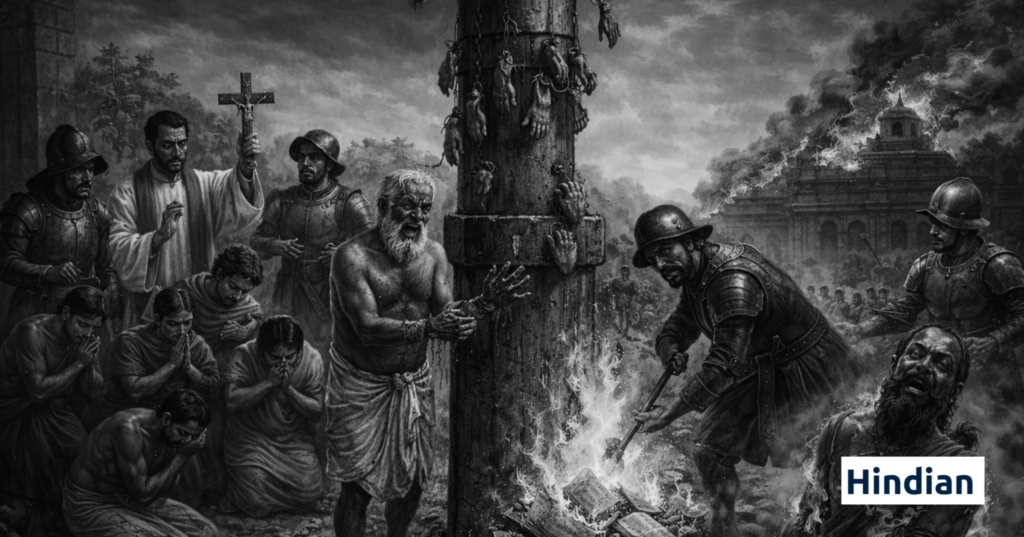
One of the most feared symbols of the Goa Inquisition was the Hath Katro Khamb, literally meaning “the pillar of severed hands.” This structure embodied the normalization of extreme cruelty as a tool of governance.
Individuals accused of practicing Hindu rituals, resisting conversion, or aiding Hindu priests were subjected to brutal punishments, including amputation of limbs. Such punishments were often carried out publicly to terrorize the population into submission.
The Hath Katro Khamb was not merely a physical structure. It represented a judicial philosophy where mutilation, torture, and spectacle were sanctioned by both church and state. Fear was institutionalized, and violence was ritualized as moral correction.
Atrocities Committed Against Hindus
The Portuguese administration systematically dismantled Hindu society in Goa.
More than a thousand temples were destroyed or converted into churches. Hindu priests were expelled or executed. Villages were forced to convert en masse. Those who fled were pursued, and those who remained lived under constant fear.
Punishments included public flogging, imprisonment, burning at the stake, mutilation, and exile. Records from Portuguese archives themselves acknowledge mass executions and torture.
Even cultural acts such as naming children, performing marriage rituals, or observing traditional fasts were punishable offenses.
This was not religious reform. It was cultural genocide.
Exodus and Forced Assimilation of Hindus
Facing relentless persecution, a significant portion of Goa’s Hindu population was forced into exile. Entire communities fled Portuguese controlled territories to neighboring regions such as Karnataka, Maharashtra, and the interior Konkan to preserve their faith, customs, and social order.
This migration was not voluntary. It was an act of survival.
Those who remained were subjected to forced assimilation. Conversion was imposed through systematic deprivation of civil rights. Hindus were denied employment, property ownership, legal protection, and access to education unless they accepted baptism. Traditional Hindu names were replaced with Portuguese Christian names, and indigenous customs were criminalized.
The objective was unambiguous: either abandon Hindu identity or abandon Goa.
This policy permanently altered Goa’s demographic and cultural landscape and created a legacy of displacement that continues to affect Goan Hindu society.
Systematic Persecution of Brahmins
Among all Hindu communities, Brahmins faced the most severe and targeted persecution. The Portuguese authorities and missionary leadership identified Brahmins as the intellectual, ritual, and philosophical foundation of Hindu society. Their destruction was considered essential to breaking Hindu resistance.
Brahmins were prohibited from performing religious rites, teaching Sanskrit texts, or maintaining temples. Many were publicly humiliated, imprisoned, tortured, or executed. Their lands were confiscated, and their families were forcibly converted.
Inquisitorial records show that Brahmins were frequently accused of secretly sustaining Hindu practices, an allegation that often resulted in capital punishment.
The persecution of Brahmins was not incidental. It was strategic. By eliminating the custodians of Hindu knowledge, the Portuguese aimed to sever the transmission of Hindu civilization itself.
Role of Christian Missionaries
Christian missionaries were not passive observers. They were ideological drivers and operational collaborators of the Inquisition.
Missionaries lobbied for stricter laws, informed on suspected practitioners of Hinduism, and justified violence as religious duty. Conversion was framed as salvation but enforced through the power of the colonial state.
The narrative of peaceful evangelism collapses under historical scrutiny. The missionary enterprise in Goa functioned in complete alignment with colonial authority and coercion.
Francis Xavier and His Hostility Toward Brahmins
Francis Xavier, later canonized by the Church, played a pivotal role in shaping the missionary attitude toward Hindus in Goa. In his letters to the Portuguese Crown, Xavier expressed explicit hostility toward Brahmins, describing them as the principal obstacle to Christian expansion.
He urged the authorities to suppress Brahmins through legal and punitive measures, arguing that Christianity could not succeed unless Brahmin influence was broken. His correspondence reflects a clear endorsement of coercion and state enforcement of religious conformity.
What Francis Xavier Wrote About Brahmins
1. Brahmins as the Primary Obstacle to Christianity
In a letter to King João III of Portugal (1545), Francis Xavier wrote:
“The Brahmins here are the most perverse people in the world.
They prevent the people from becoming Christians by telling them lies and deceits.”
This statement clearly identifies Brahmins as the principal enemy of missionary efforts, not merely religious rivals but active threats requiring suppression.
2. Call for State Action Against Brahmins
In another letter, Xavier explicitly demanded government intervention:
“If Your Highness does not order that the Brahmins be punished and restrained, Christianity will never grow in these parts.”
This is critical. Xavier was not asking for debate or dialogue. He was urging legal and punitive action by the colonial state against Brahmins.
3. Demand for the Inquisition
In correspondence often cited as foundational to the Goa Inquisition, Xavier complained that converts were secretly maintaining Hindu practices under Brahmin influence:
“Many who become Christians return secretly to the rites of their ancestors, because the Brahmins persuade them to do so.
A remedy must be applied.”
This “remedy” was not theological reform. It became the Goa Inquisition.
4. Brahmins Portrayed as Deceivers of Society
Xavier also framed Brahmins as social corrupters:
“The Brahmins deceive the people, teaching them that their false gods are true, and that Christian law is false.”
Such language dehumanized Brahmins and morally justified their persecution in the eyes of colonial authorities.
These writings reveal the ideological foundation behind the Inquisition. Xavier’s advocacy directly contributed to the establishment and intensification of religious persecution in Goa.
The continued veneration of Xavier stands in stark contrast to the historical consequences of his actions.
Suppression of Language and Identity
The Portuguese actively suppressed indigenous languages and educational systems. Sanskrit and Konkani were discouraged or banned, while Portuguese became the language of administration, power, and social mobility.
Traditional gurukuls disappeared. Indigenous knowledge systems were delegitimized. Goa was reshaped to mirror European Christian norms, severing it from its civilizational roots.
Decline of the Inquisition and Lingering Control
The Goa Inquisition was officially abolished in 1812, driven more by political pressure in Europe than by moral reform. However, its social and psychological consequences endured.
Discrimination against Hindus persisted through administrative bias, land control, and cultural dominance. Portuguese rule continued for another century and a half.
Liberation of Goa and Restoration of Freedom
While India achieved independence in 1947, Goa remained under Portuguese occupation. The colonial regime refused to decolonize, declaring Goa an overseas province.
After prolonged diplomatic efforts failed, India launched Operation Vijay in December 1961. Portuguese rule collapsed within days.
Goa was liberated, not gifted freedom.
Liberation restored the right of Hindus to worship openly, rebuild temples, and reclaim cultural identity without fear.
Post Liberation Reality and Historical Amnesia
Despite liberation, the atrocities of the Goa Inquisition remain insufficiently acknowledged. There has been no formal apology from Portugal, no reparations, and no global reckoning.
Worse, public discourse often downplays Portuguese brutality, portraying it as benign colonialism. Such selective memory distorts history and dishonors the victims.
Truth, not silence, is the foundation of reconciliation.
The Goa Inquisition was a crime against humanity executed under the guise of faith and empire. It was a calculated assault on Hindu civilization, carried out through law, violence, and terror.
Remembering this history is not an act of hatred. It is an act of justice.
Goa’s liberation was not merely political. It was civilizational reclamation.
History must record it as such.

