
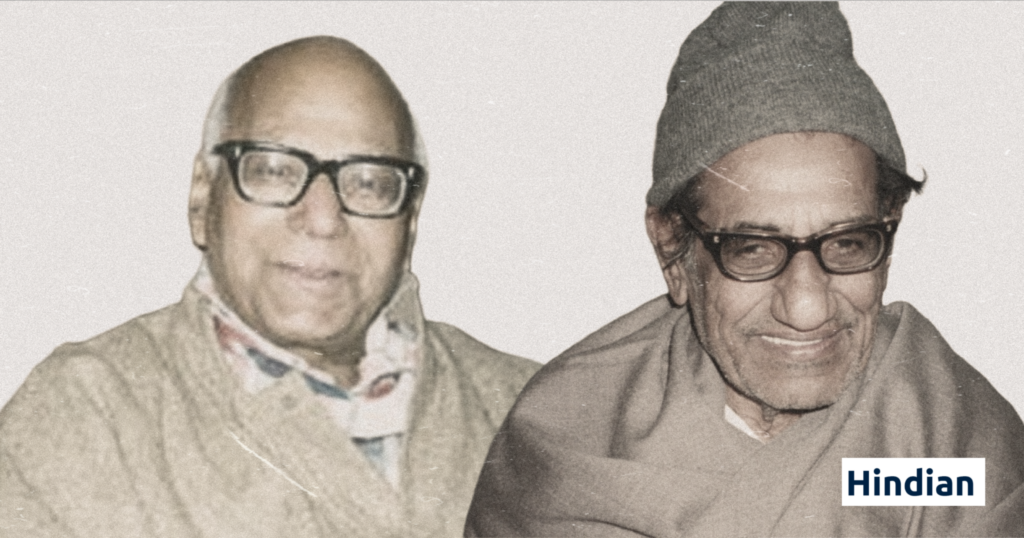
In the post-independence intellectual landscape of India, Hindu civilization faced a profound crisis. While political freedom was achieved in 1947, the control of narrative, education, and historical interpretation largely remained in the hands of ideologically motivated actors. Hindu society, rich in spiritual practice, ritual, and philosophy, lacked the intellectual defenders necessary to preserve its civilizational memory. Into this vacuum stepped Ram Swarup and Sita Ram Goel, two thinkers whose works continue to challenge the dominant narratives imposed upon Hindu civilization.
These men were not mere critics; they were scholars, philosophers, and historians committed to the truth of Hindu thought, unafraid to confront uncomfortable realities or question political convenience.
Ram Swarup: Philosopher of Hindu Consciousness
Perspective
Ram Swarup (1920–1998) approached Hinduism not as a “religion” in the Abrahamic sense but as a civilization of consciousness, a spiritual matrix encompassing philosophy, ethics, and culture. He rejected the notion that Hinduism required validation through Western frameworks or Abrahamic paradigms. For Swarup, Hinduism was complete in itself, rooted in experience, logic, and the pursuit of truth.
He consistently argued that Hindu pluralism, the coexistence of multiple paths, deities, and philosophies, is a strength, not a weakness. Truth, Swarup emphasized, cannot be monopolized, and spiritual diversity is intrinsic to the Hindu worldview.
“A religion must be judged not by its slogans, but by its scriptures and historical behavior.”
Key Contributions
a) Critique of Abrahamic Religions
In Understanding Islam Through Hadis (1979), Swarup engaged with Islamic scripture using canonical Hadith texts. His analysis revealed:
• The doctrinal roots of political supremacy in Islam
• Historical instances of violence justified by theology
• Lack of intrinsic pluralism within doctrinal frameworks
Similarly, Swarup’s essays on Christianity exposed the consequences of theological absolutism, missionary activity, and ideological cultural dominance.
b) Defense of Hindu Civilization
In On Hinduism and The Word as Revelation, Swarup articulated a philosophy of Hinduism that emphasized experience over dogma, pluralism over uniformity, and civilizational confidence over apologetic posture. His work encouraged Hindus to view their civilization as a living, rational, and spiritually profound entity.
c) Critique of Ideologies
Swarup was also critical of Marxist reductionism. Through works like Gandhism and Communism and Foundations of Maoism, he demonstrated how materialist frameworks strip culture and spiritual consciousness of depth, replacing ethical considerations with economic determinism.
Sita Ram Goel: Historian and Defender of Truth
Perspective
Sita Ram Goel (1921–2003) was a historian, polemicist, and civilizational chronicler. Unlike Swarup, Goel focused primarily on historical documentation and textual analysis. His scholarship revealed the systematic marginalization of Hindu society and the suppression of Hindu history by colonial, missionary, and post-colonial institutions.
Goel’s work was characterized by meticulous sourcing, textual evidence, and refusal to sanitize uncomfortable truths. He believed that Hindus must confront their history without fear to reclaim their civilization.
Key Contributions
a) Hindu Temples: What Happened to Them
Goel’s seminal two-volume study is a meticulous account of the destruction of Hindu temples during Islamic rule in India. Drawing on Persian, Arabic, and indigenous sources, Goel demonstrated:
• Systematic, ideologically sanctioned temple destruction
• Political and religious motivations behind architectural annihilation
• The erasure of cultural memory and knowledge
This work challenged the notion that temple destruction was accidental or purely political, emphasizing its civilizational impact.
b) History of Hindu-Christian Encounters
In this work, Goel traced missionary and colonial strategies aimed at cultural subversion and conversion. He revealed how historical distortions, economic leverage, and psychological strategies systematically undermined Hindu self-confidence.
c) Critique of Pseudo-Secularism
Goel analyzed Indian secularism as asymmetric and biased. He argued that Hindu institutions were frequently controlled or constrained, while other religious groups were often appeased. This imbalance, he asserted, had profound implications for civilizational continuity and political morality.
d) How I Became a Hindu
This autobiographical work traces Goel’s personal journey from Marxist skepticism to Hindu civilizational affirmation, offering readers a roadmap of intellectual awakening grounded in evidence, reason, and conscience.
Voice of India: Creating a Platform for Hindu Scholarship
Both thinkers recognized that mainstream publishers and academia often ignored, censored, or attacked Hindu scholarship. To combat this, they co-founded Voice of India, a publishing platform dedicated to:
• Preserving marginalized Hindu scholarship
• Publishing works ignored by mainstream academia
• Creating a sustained intellectual foundation for future generations
Voice of India remains a cornerstone for serious students of Hindu history, philosophy, and culture.
Central Themes in Their Thought
• Civilizational Confidence: Hinduism must be approached as a living civilization, not merely as a religion.
• Historical Clarity: Understanding history honestly is essential for cultural survival.
• Intellectual Courage: Avoid apologetic stances; engage critically with all ideologies.
• Pluralism and Integrity: True Hindu thought embraces diversity, reason, and ethical rigor.
• Warning Against Ideological Drift: Political parties and popular movements are transient; principles endure.
One widely circulated attribution to Goel captures this warning (though its precise sourcing is debated):
“With time, Congress will turn into the Muslim League, and BJP will become the next Congress.”
This statement reflects their shared concern: without intellectual vigilance, political power alone cannot preserve a civilization.
Why Every Hindu Should Read Them
• To reclaim intellectual sovereignty: Without knowledge of Hindu history and philosophy, emotional religiosity is vulnerable to distortion.
• To understand ideological threats: Swarup and Goel expose the mechanisms of cultural erasure and political appeasement.
• To develop analytical rigor: They teach how to critique objectively, without vulgarity or extremism.
• To preserve civilizational memory: Their work connects present generations to millennia of Hindu intellectual and cultural heritage.
Recommended Works
Ram Swarup
• On Hinduism
• Understanding Islam Through Hadis
• The Word as Revelation
• Gandhism and Communism
• Foundations of Maoism
Sita Ram Goel
• Hindu Temples: What Happened to Them (Vol I & II)
• History of Hindu-Christian Encounters
• How I Became a Hindu
• Defence of Hindu Society
Ram Swarup and Sita Ram Goel were more than writers; they were civilizational sentinels. They warned that forgetting history, losing intellectual rigor, or deferring to ideological convenience would imperil Hindu society more than any external threat.
Studying them is not optional. It is an act of dharma, a commitment to truth, history, and the enduring spiritual civilization that is Hinduism.
Their works remain a treasury of insight, courage, and intellectual integrity, essential reading for anyone serious about understanding, defending, and revitalizing Hindu civilization.

